

A Miami spa lives or dies on mobile. Someone standing on Lincoln Road searches “hydrafacial near me,” taps your site, and decides in about three seconds whether to book you or bounce back to Google and tap the next studio. If your website is built on a bloated WordPress theme with a dozen plugins, you are losing that client before your before/after gallery ever loads.
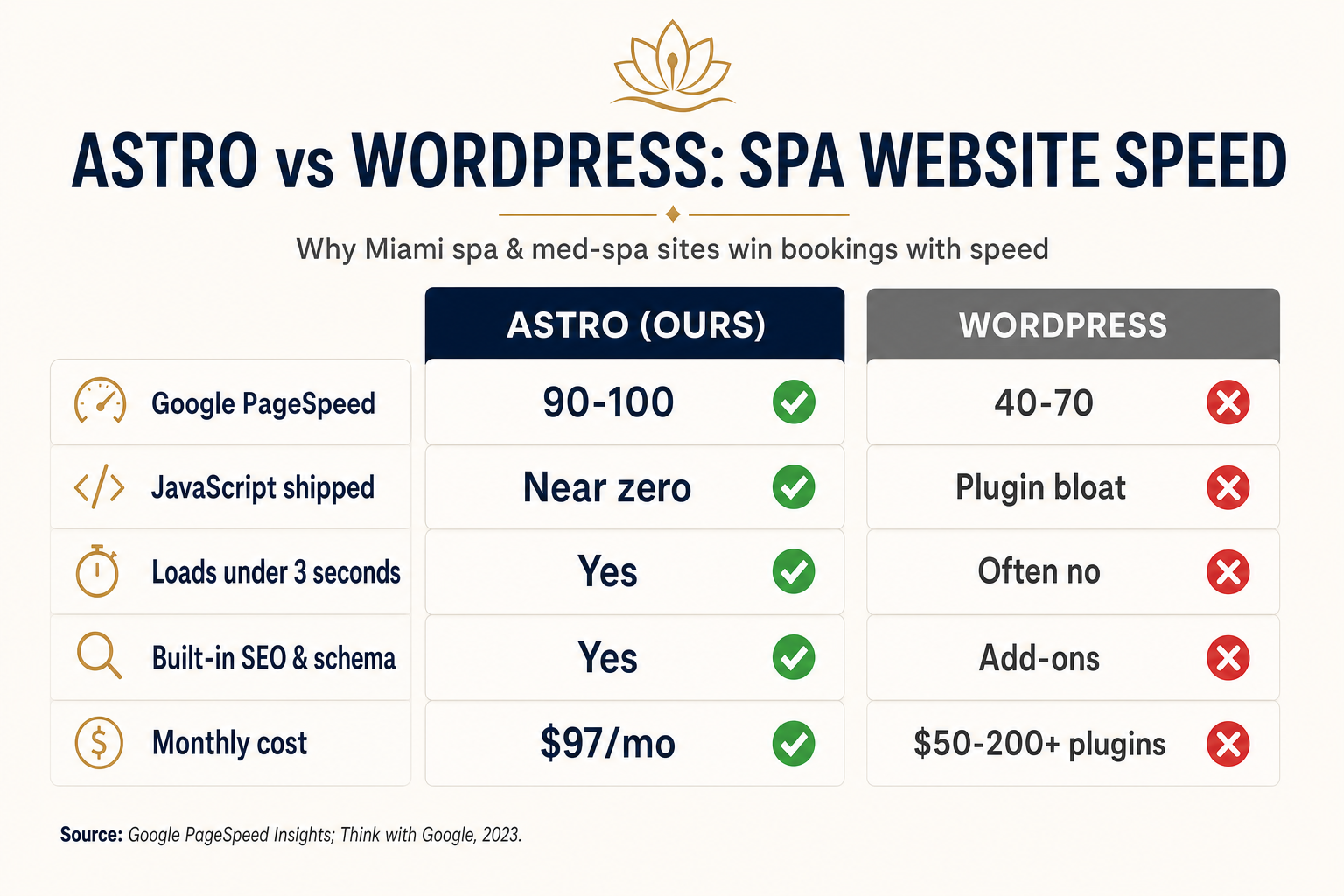
The short answer: for a Miami spa or med-spa website, Astro beats WordPress on the metric that actually converts — raw page speed. Only about 43% of WordPress sites pass Google’s Core Web Vitals, the lowest of any major platform, while roughly 67% of Astro sites pass (Search Engine Journal / Google CrUX). A hand-built Astro site can be tuned to a 90–100 PageSpeed score on mobile and desktop, because it ships almost no JavaScript by default (Astro docs). Faster site, more booked treatments. Everything below is the data behind that sentence — and what it’s worth to a spa in a market as competitive as South Florida.
Table of contents
- Why page speed decides Miami spa bookings
- Astro vs WordPress: the Core Web Vitals data
- Why WordPress is slow (and why Astro isn’t)
- Feature-by-feature comparison
- The booking math: what a slow site costs a Miami spa
- When WordPress still makes sense
- The done-for-you option
- Frequently asked questions
Why page speed decides Miami spa bookings
Miami is one of the most saturated aesthetics markets in the country. The global medical spa market hit roughly $24.2 billion in 2025 and is growing at a 15.9% CAGR toward an estimated $78.2 billion by 2033 (Grand View Research), and the U.S. footprint is expanding fast — AmSpa counted 8,899 med spas in 2022, rising to 10,488 in 2023 and tracking toward roughly 13,000 (AmSpa 2024 State of the Industry). In a market that dense, the website is the tiebreaker.
And spa traffic is overwhelmingly local and mobile. 76% of people who search for something nearby on a smartphone visit a related business within a day (Think with Google). That “botox near me” or “lash fill Brickell” searcher is high-intent and impatient. The only thing standing between them and a booked appointment is how fast your page paints on a phone.
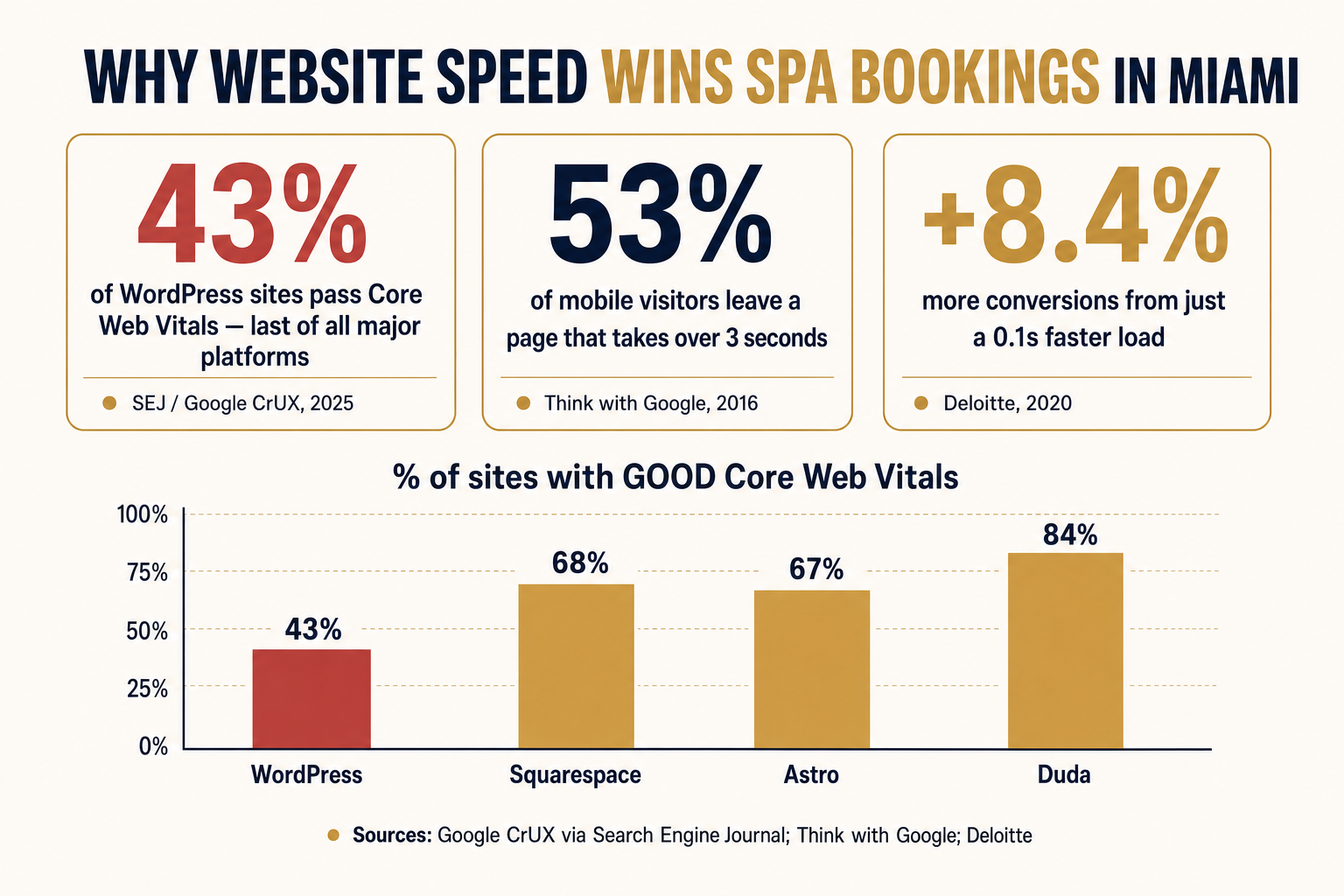
Here’s the uncomfortable number: 53% of mobile site visits are abandoned if the page takes longer than three seconds to load, and as load time stretches from one second to three, the probability that a visitor bounces climbs 32% — at five seconds it’s 90%, and at seven seconds 113% (Think with Google). You can run flawless Instagram ads and still hemorrhage those clicks if the landing page is slow.
Speed isn’t a vanity metric for a spa. It’s the width of the door your clients walk through.
Astro vs WordPress: the Core Web Vitals data
Core Web Vitals are Google’s three measured signals for real-world page experience — largest contentful paint (loading), interaction to next paint (responsiveness), and cumulative layout shift (visual stability). Google folds them into its page-experience ranking signals, so they influence both whether a client stays and whether you show up in the first place (Google Search Central).
When Search Engine Journal analyzed real Chrome User Experience (CrUX) field data across platforms, the split was stark. Only 43.4% of WordPress sites earned a “good” Core Web Vitals score — the lowest of any major CMS. Modern hosted builders and Astro cleared it comfortably, with Astro sites around 67% (Search Engine Journal).
Two honest caveats matter here. First, these are platform aggregates — they blend every site on the platform, from carefully built to abandoned. A professionally built site scores higher than its platform’s average. Second, Astro’s aggregate lands near the hosted builders, not miles above them. So the real story isn’t “Astro is magic.” It’s this: WordPress starts you in a hole, and a purpose-built Astro site — the kind we tune to a guaranteed 90+ PageSpeed — clears the bar with room to spare.
The mechanism behind bounce is worth seeing on its own, because it’s the curve every Miami spa is fighting:
Why WordPress is slow (and why Astro isn’t)
WordPress isn’t slow because the people who use it are careless. It’s slow because of how it’s architected for a spa’s needs. WordPress powers roughly 43% of all websites — about 60%+ of the entire CMS market (W3Techs) — precisely because it’s flexible and plugin-driven. But that flexibility is the tax.
A working spa WordPress site typically stacks a page-builder (Elementor, Divi), a booking plugin, a slider, a forms plugin, a cookie banner, analytics, and a caching plugin to try to undo the damage. Each one injects its own CSS and JavaScript into every page. The median web page already ships about 570 KB of JavaScript on mobile (HTTP Archive Web Almanac 2024) — and a plugin-heavy WordPress build routinely lands at the high end of that. On a mid-range phone over Miami LTE, that JavaScript has to download, parse, and execute before your site feels usable.
Astro attacks the problem at the root. It renders your pages to static HTML at build time and ships zero client-side JavaScript by default — its “islands architecture” hydrates only the genuinely interactive bits (a booking widget, a chat bubble) and leaves everything else as plain, instant HTML (Astro docs). Pages are served static-first from a global edge network, so a client in Coral Gables gets the same near-instant load as one in Wynwood.
Feature-by-feature comparison
Speed is the headline, but a spa website has to do a real job — book treatments, rank locally, look premium, and stay editable. Here’s how the two stack up for a Miami studio.
Astro spa website vs. WordPress — for a Miami spa
| Plan | Astro (our build) recommended | Typical WordPress |
|---|---|---|
| Price | $497 + $97/mo | Hosting + plugins |
| Feature 1 | 90–100 PageSpeed, guaranteed | 43% of sites pass Core Web Vitals |
| Feature 2 | Near-zero JavaScript by default | Plugin/theme JavaScript on every page |
| Feature 3 | Static-first, served from the edge | Server-rendered, cache plugins to patch |
| Feature 4 | SEO, schema & local pages built in | SEO & schema via add-on plugins |
| Feature 5 | Managed — no plugin updates for you | You (or a dev) maintain updates |
| Feature 6 | AI chat widget + CRM wired in | Chat & CRM = more paid plugins |
| Feature 7 | Hardened surface, static hosting | Larger attack surface to patch |
| See the build |
The pattern is consistent: on WordPress, most of what a spa needs is bolted on — and every bolt-on is more code, more maintenance, and more that can break at 9pm before a launch. On a purpose-built Astro site, booking, local SEO and schema, the conversion-ready page structure, and the chat/CRM layer are engineered in from the start.
The booking math: what a slow site costs a Miami spa
Let’s put dollars on it. The conversion research is unusually clean here. Deloitte’s “Milliseconds Make Millions” study, run with Google, found that a 0.1-second improvement in mobile load time lifted retail conversions by 8.4% and average order value by 9.2% — and travel conversions by 10.1% (Deloitte via web.dev). Portent’s analysis of real ecommerce data found conversion rates peak for pages that load in 0–4 seconds and fall with every additional second (Portent).
Now apply that to a mid-sized Miami med-spa. Say your site brings 2,000 mobile visitors a month, 6% book a consult, and your average first treatment plus follow-ups is worth $450.
Even a conservative single-digit lift from cutting your load time in half is roughly ten extra booked consults a month — about $4,500 on those numbers, or $54,000 a year from the same ad spend and the same traffic. A slow WordPress site doesn’t just annoy clients; it quietly taxes every marketing dollar you spend to get them there. (This is the same reason speed-to-lead matters once they do raise their hand.)
When WordPress still makes sense
Fair is fair. WordPress is the right tool in a few cases, and pretending otherwise would be marketing, not advice:
- You publish heavily and self-manage. If you’re posting long-form blog content weekly and want a familiar in-house editor, WordPress’s ecosystem is deep. (Though our Astro builds include an auto-blogging option that publishes for you.)
- You have a specific plugin dependency. A niche membership or LMS plugin with no equivalent elsewhere can anchor you to WordPress.
- You already have an in-house developer who keeps it fast, updated, and secure — a genuinely well-maintained WordPress site can pass Core Web Vitals; it’s just the harder path.
For most Miami spa and med-spa owners, though, none of those apply. You want a premium, fast site that fills the schedule and that you never have to patch. That’s exactly the gap a done-for-you Astro build closes.
The done-for-you option
You didn’t open a spa to babysit plugin updates. The practical move for most studios is a managed, purpose-built Astro site: we design and build it, guarantee a 90+ Google PageSpeed (often a perfect 100) on mobile and desktop, wire in local SEO, schema, an AI chat widget, and your CRM, and host and maintain it for you — $497 one-time + $97/month, live in about ten working days. Add auto-blogging for $197/month total, or cover up to five locations under one bulk plan.
If you’re weighing your whole stack — website, booking, and follow-up — it’s worth seeing how the prebuilt spa website fits with the rest of the Beauty & Spa Snapshot, and how a fast site pairs with the workflows that actually get more spa clients in the door.
The verdict for a Miami spa in 2026 is simple: WordPress can be made fast, but Astro is fast by default — and in a three-second market, default wins.
Frequently asked questions
Astro vs WordPress for spa websites — FAQs
Is Astro really faster than WordPress for a spa website?
By the data, yes. Only about 43% of WordPress sites pass Google's Core Web Vitals — the lowest of any major platform — versus roughly 67% of Astro sites (Search Engine Journal / Google CrUX). Astro ships almost no JavaScript by default and serves static-first pages from the edge, so a professionally built Astro site is routinely tuned to a 90–100 PageSpeed score on mobile.
Why does website speed matter so much for a Miami spa?
Spa traffic is local and mobile, and impatient: 53% of mobile visitors abandon a page that takes more than three seconds to load (Think with Google), and 76% of people searching for a nearby business on their phone visit within a day. In a market as saturated as Miami, a slow site sends high-intent 'near me' searchers straight to a competitor.
Can I move my existing WordPress spa site to Astro?
Yes. A migration rebuilds your pages, treatment and location content, and booking flow on Astro, then repoints your domain — your URLs and SEO are preserved. Our done-for-you build handles the migration, hosting, and ongoing maintenance so you never touch a plugin update again.
What does a fast Astro spa website cost?
Our managed Astro build is $497 one-time plus $97/month, which covers a guaranteed 90+ PageSpeed site, free domain, managed Cloudflare hosting, SSL, an AI chat widget, CRM, and maintenance. Add auto-blogging for $197/month total, or cover up to five locations for a $1,200 one-time fee plus $297/month.
Does a faster website actually help me rank on Google?
It helps. Core Web Vitals are part of Google's page-experience ranking signals, so a faster, more stable site is a positive signal — and just as importantly, it keeps the visitors you earn from bouncing, which is itself a quality signal. Speed alone won't outrank great content and local SEO, but a slow site actively holds you back.
Devon Ashby runs a small agency that resells GoHighLevel snapshots and builds fast websites for day spas, lash studios, and med-spas across the Southeast. He came up through performance marketing, so he treats every spa site like a P&L — cost per booked consult, package conversion, and lifetime value. He writes the numbers-first pieces on speed, funnels, and local SEO for beauty businesses.