

A regular you have seen every month for a year walks right past your window and into the Massage Envy two doors down. Not because they are better. Because she has a membership there, the app already has her card, and booking took ten seconds on the train. You gave her the better massage and the warmer welcome, and you still lost her, because the chain made staying easy while you made her call during business hours and hope.
That is the whole fight in one scene. The chains do not beat you on skill. They beat you on lock-in and convenience, two things you can copy this month without a franchise fee. Here is the playbook, with the exact texts you can steal today.
Table of contents
- What the chains actually sell you against
- What it costs you to keep losing to them
- The six-part independent playbook
- Part 1: Build a membership better than theirs
- Part 2: Win the booking moment they win on convenience
- Part 3: Rebook her before she walks out the door
- Part 4: Follow up like a person, not a franchise
- Part 5: Win the local reviews war
- Part 6: Sell what a chain physically cannot
- Run the playbook for your size
- The legal fine print on texts and offers
- Objections I hear from owners every week
- Frequently asked questions
Key takeaways
What the chains actually sell you against
The chains are not selling a better treatment. They are selling two things you can copy.
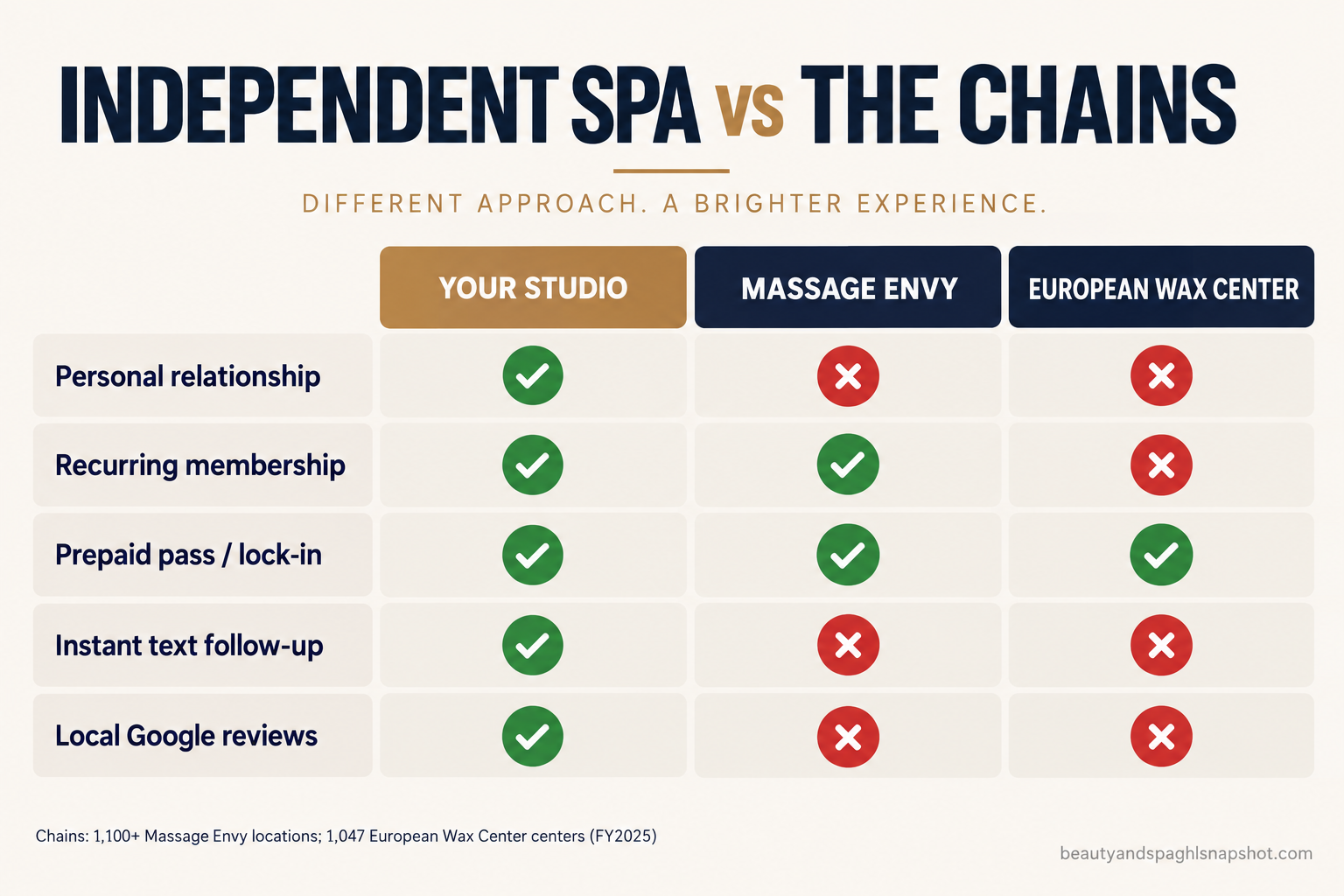
Massage Envy sells a habit. It runs on a monthly wellness membership: one 60-minute session a month, unused sessions roll over, discounted rates on extras. The fee is set per franchise and commonly lands around $60 to $70, so the client pays whether or not she books, which is why she keeps booking. The Massage Envy memberships page is built around it, and the network runs more than 1,100 locations, almost all franchises.
European Wax Center sells prepayment. Its lock-in is the Wax Pass: buy nine waxes, get three free, so you have paid for a year before your second visit. Same idea, get the commitment up front. The public company’s fiscal 2025 filing reports 1,047 centers in 44 states with $947.3 million in system-wide sales.
Neither model is magic. Both just make the second visit automatic, plus convenience wins: an app with your card, booking at 11pm, a predictable menu in any city. What they give up for that is the one thing you already have, a real relationship. You are not competing with their massage, you are competing with their friction, and friction is beatable.
Sources: US spa industry revenue, ISPA / PwC 2024 US Spa Industry Study; EWC center count, EWCZ FY2025 results; Massage Envy locations, Massage Envy; repeat-client revenue share, Zenoti 2025 Benchmark Report.
What it costs you to keep losing to them
Here is the number that reframes the whole problem. The Zenoti 2025 Beauty and Wellness Benchmark Report, built on data from more than 30,000 brands, found the 42% of clients who visit more than once a year generate around 80% of revenue, while the 58% who come once contribute just 20%. Your business is the clients who come back, not the new faces.
Share of total revenue by client type. Source: Zenoti 2025 Benchmark Report.
Now put a dollar on it. If your average service is $110 and a loyal client comes back monthly, that is over $1,300 a year, several thousand across a few years. Lose her after one visit and you lost the whole relationship plus the cost to acquire her, not just $110. We break the math down in our guide to spa client lifetime value.
Harvard Business Review, drawing on Bain research, reports that raising retention by 5% lifts profits 25% to 95%. The chains build every system around the automatic second visit. Most independents still do nothing between visits. That gap is what you close.
The six-part independent playbook
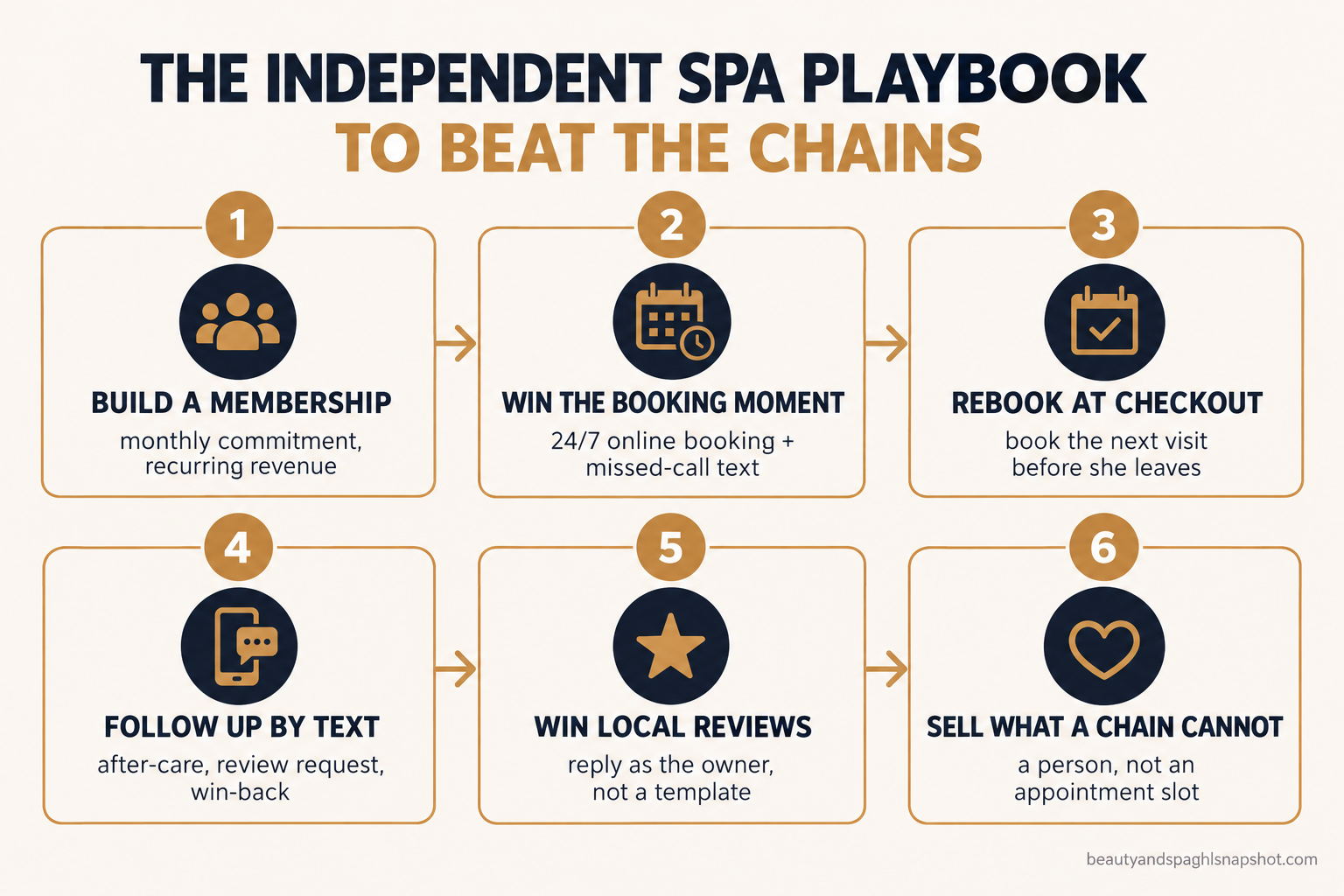
You beat their structure with your own. Six parts, in order of return:
- Build a membership better than theirs.
- Win the booking moment where they win on convenience.
- Rebook her before she walks out the door.
- Follow up like a person, not a franchise.
- Win the local reviews war.
- Sell what a chain physically cannot.
None of it needs a franchise fee. It needs a system that runs in the background, so it happens every time.
Part 1: Build a membership better than theirs
This single move turns lumpy walk-in revenue into money you can count on. Copy the good part of the Massage Envy model, a monthly commitment that makes the next visit automatic, and drop what feels corporate.
Your version: a monthly membership at a fair price that includes one signature service, rolls unused visits over, and adds a members-only perk the chain cannot match, like a standing appointment time, a retail discount, or priority on busy weekend slots.
The invite that signs people up is delivered at checkout, right after a great visit, not in a mass email:
You are in about once a month anyway, so the membership
pays for itself: your [signature facial] every month at
[member price], your regular time held, and 10% off any
retail. Want me to set it up before you go?
How it breaks: owners launch a membership, tell nobody, and wait for it to sell itself. It will not. Every monthly client gets the offer at the desk, and it goes on your booking confirmation and after-care texts. For the full build, with pricing tiers and the retention math, see our walkthrough on building a spa membership program. Promoted properly, it is your version of the chain’s recurring revenue.
Part 2: Win the booking moment they win on convenience
The chain has a booking button that works at midnight and an app with the card on file. When your client is deciding at 9pm on a Sunday, the business that lets her book in three taps wins, and too often that is not you.
Close the gap two ways. First, real online booking on your site and Instagram, open 24/7. Second, catch the inquiries you miss: when a call goes unanswered, an automatic text fires within seconds:
Hi [First name], this is [Studio] returning your call. So
sorry we missed you! You can grab any open time right
here: [booking link], or reply and I will help. Reply
STOP to opt out.
That turns a missed call into a booking instead of a voicemail nobody checks, and we cover the whole flow in missed-call text-back for spas. The after-hours web and DM inquiry gets the same instant reply with a link, so the Sunday-night shopper books with you, not the chain that answered first.
How it breaks: the booking link dumps her into a long intake form before she picks a time, and she bounces. Ask for the minimum to hold the slot and take the rest at the visit. The client who gets an answer first books first.
Part 3: Rebook her before she walks out the door
This is the cheapest booking you will ever get, and where you lap the chains. Zenoti found top salons rebook about 30% of clients within 24 hours, versus a 10% industry average, a three-fold gap on the easiest appointment in the business.
Share of clients rebooked within 24 hours of a visit. Source: Zenoti 2025 Benchmark Report.
The habit is a front-desk script that books the next visit before she pays, framed as care, not a sales push: “Your skin will want this again in about four weeks to hold the results. I have [provider] Thursday the 12th at 10, want me to save it?” For anyone who leaves without rebooking, an automatic text the next morning closes the loop:
Hi [First name], loved having you in yesterday! To keep
your results, most clients come back in [4 to 6] weeks.
Here is my calendar so you can grab your spot: [booking
link]. Reply STOP to opt out.
How it breaks: the front desk asks “do you want to rebook?” as a yes-or-no question, and the tired client says “I’ll call.” Never ask. Offer a specific day and time and let her say yes. If she takes a slot you would rather protect, take a deposit using the language in our no-show playbook. Most spas lose clients to the second visit nobody ever booked, not to a competitor.
Part 4: Follow up like a person, not a franchise
Here is your unfair advantage. The chain sends a generic app push; you send a text that sounds like the person who did the treatment, and it gets read: SMS averages a 98% open rate, most messages read within minutes, against email near 20%.
Three follow-ups do most of the work, and none feels like marketing.
An after-care text a few hours later:
Hi [First name], it was so nice seeing you today. Drink
plenty of water tonight and skip heavy exercise for 24
hours to get the most from your treatment. Text me here
with any questions!
A review request two days later, once she is happy:
Hi [First name], hope you are still glowing! If you have
20 seconds, a quick Google review helps other locals find
us: [review link]. Thank you so much.
And a win-back for a client who has drifted, aimed at the service she used to book:
Hi [First name], it's [Studio]. It has been a while since
your last [service] and we would love to have you back. I
saved you a spot this week, your pick of day: [booking
link]. Reply STOP to opt out.
How it breaks: you blast the whole lapsed list one Monday morning instead of dripping it. Reactivate a small batch each week and keep it personal. For win-backs that read like a human, use our guide to reactivating lapsed spa clients.
Part 5: Win the local reviews war
This is the fight the chain cannot win against you, because reviews are local. When someone searches “facial near me,” she is reading your recent Google reviews against the studio down the street, not comparing you to a national brand. And reviews decide it: BrightLocal’s 2025 Local Consumer Review Survey found roughly 93% of consumers read online reviews before choosing a local business.
You win by making the ask automatic (the review text in Part 4) and timing it right: two days after a great visit. Then reply to every review in your own voice, as the owner who remembers the appointment, not a corporate template.
How it breaks: owners protect their rating by only asking clients they know are happy, or route unhappy ones to a private form instead of Google. That is review-gating, and it is illegal now (covered below). Ask everyone and fix the unhappy ones. We lay out a compliant system in our guide to earning 12 Google reviews a month.
Part 6: Sell what a chain physically cannot
The last part is positioning, and it costs nothing. A franchise sells sameness: the same 50-minute service, the same menu, the same room, in any city. A feature for a traveler, a weakness for a neighbor. So sell the opposite. You remember her name and her sensitivity, you spend the extra ten minutes where it is needed, and you are one text away, not a phone tree. Do not say “we are cheaper,” because you usually are not. Say “you are a person here, not an appointment slot,” and mean it. That is the one line a 1,047-location chain can never honestly write.
Run the playbook for your size
The six parts are the same. How hard you lean on each depends on your shop.
Solo or 1 to 2 chairs. You cannot run six systems by hand, so automate the two with the highest return: the missed-call text-back (Part 2) so a Sunday inquiry does not go to the chain, and the checkout rebook (Part 3) so you never rely on remembering. Launch a simple one-tier membership and offer it to every regular.
Mid-size team, 3 to 8 providers. Your problem is consistency: one provider rebooks every client, another never does. Standardize the checkout script and follow-up texts so they fire the same for everyone, and add a small staff incentive for sign-ups and rebookings. This is the size where a membership throws off real recurring revenue.
Multi-location. Now you compete on the chains’ own terms, so borrow their strengths: one booking experience across sites, a membership usable at any location, and one dashboard tracking rebooking and membership growth per site. Your edge is still local, so keep each location’s reviews and voice specific.
The legal fine print on texts and offers
Everything above leans on texting and reviews, so get the basics right.
Texting (TCPA). You need clear consent before marketing texts, and every promotional message must offer a real opt-out, which is why the STOP line is in the templates above. Honor STOP immediately and text only during reasonable hours. Our spa SMS marketing guide has the consent language, and the FCC’s guidance on unwanted texts is the start.
Reviews and offers (FTC). The FTC’s 2024 rule bans fake reviews, and review-gating (asking only happy clients to post) is an explicit violation. Before-and-after results must be typical or clearly disclosed. The FTC’s endorsement guidance covers it.
A note for med spas. A pure day spa doing facials, waxing, massage, and nails is generally not a HIPAA-covered entity: no protected health information, no insurance billing. Once licensed medical providers perform medical procedures, that changes. Keep intake forms, treatment photos, and consult notes out of unsecured SMS and email, and keep marketing texts to scheduling and generic service names. Our spa marketing compliance guide covers where that line sits.
Objections I hear from owners every week
“Aren’t the chains just cheaper?” Often yes, and you should not try to win there. The client who chooses purely on price was never loyal to anyone. Compete for the one who wants to feel remembered, and she will pay more if you make staying easy.
“Shouldn’t my booking software already do all this?” It holds the calendar and takes payment, but most of it does not run a membership, fire a missed-call text, drip reactivation, or route reviews. Owners bolt those on, and the base bill keeps climbing: Mangomint moved to $120 a month per location plus $10 per user on August 1, 2026. Paying more for the calendar does not build the follow-up.
“Won’t a membership discount my best clients?” Only if you price it as a discount instead of a commitment. A member pays every month whether or not she books, and the perks that cost you little are what she values. Priced right, it raises the annual value of your regulars.
“I can’t compete with their marketing budget.” You do not need to. Their budget buys national awareness; yours buys the next appointment from a client who already knows you, which is cheaper and converts far better. The playbook is nearly free to run, because it works your existing clients. It also fills the quiet part of the week, covered in why your spa is empty midweek.
Frequently asked questions
How does an independent spa compete with Massage Envy?
On retention and relationship, not price or scale. Build your own monthly membership so the next visit is automatic, match the chain's 24/7 online booking and instant text replies, and rebook every client before she leaves. You copy their lock-in and keep the care a franchise cannot fake.
Should I start a membership like Massage Envy's?
Yes. A membership turns unpredictable walk-in revenue into recurring income, the highest-return move for most independents. Copy the monthly commitment, add a local perk they cannot match like a standing time slot, and offer it at checkout to every client who already visits monthly.
Why do repeat clients matter more than new ones?
Because they are the money. The Zenoti 2025 benchmark found the 42% of clients who visit more than once a year generate about 80% of revenue, while one-time clients contribute just 20%. Rebooking an existing client is far cheaper than acquiring a new one.
What is the fastest way to stop losing clients to the chains?
Rebook the next appointment before the client leaves your desk. Top salons rebook about 30% of clients within 24 hours versus a 10% industry average, and it costs nothing. Add an automatic next-morning text for anyone who left without booking.
Is texting clients about appointments legal?
Yes, with consent. The TCPA requires clear opt-in, a real opt-out like STOP on every message, and reasonable sending hours. Honor opt-outs immediately, and keep any protected health information out of SMS for med spas.
The takeaway
You cannot out-scale a thousand-location chain, and you do not need to. They win on lock-in and convenience, and both are things you can build in a month: your own membership, real online booking, instant follow-up, and a rebooking habit that happens. Add the reviews and the personal touch a franchise can never fake, and you are not the smaller option anymore. You are the better one that is also easy to stay with.
Back to that regular who walked past your window. In a studio running this playbook, she never had to: she was a member, her next visit was already booked, and the morning-after text was signed by the person who did her treatment. Same hands, same room, one relationship the chain two doors down could not buy.