
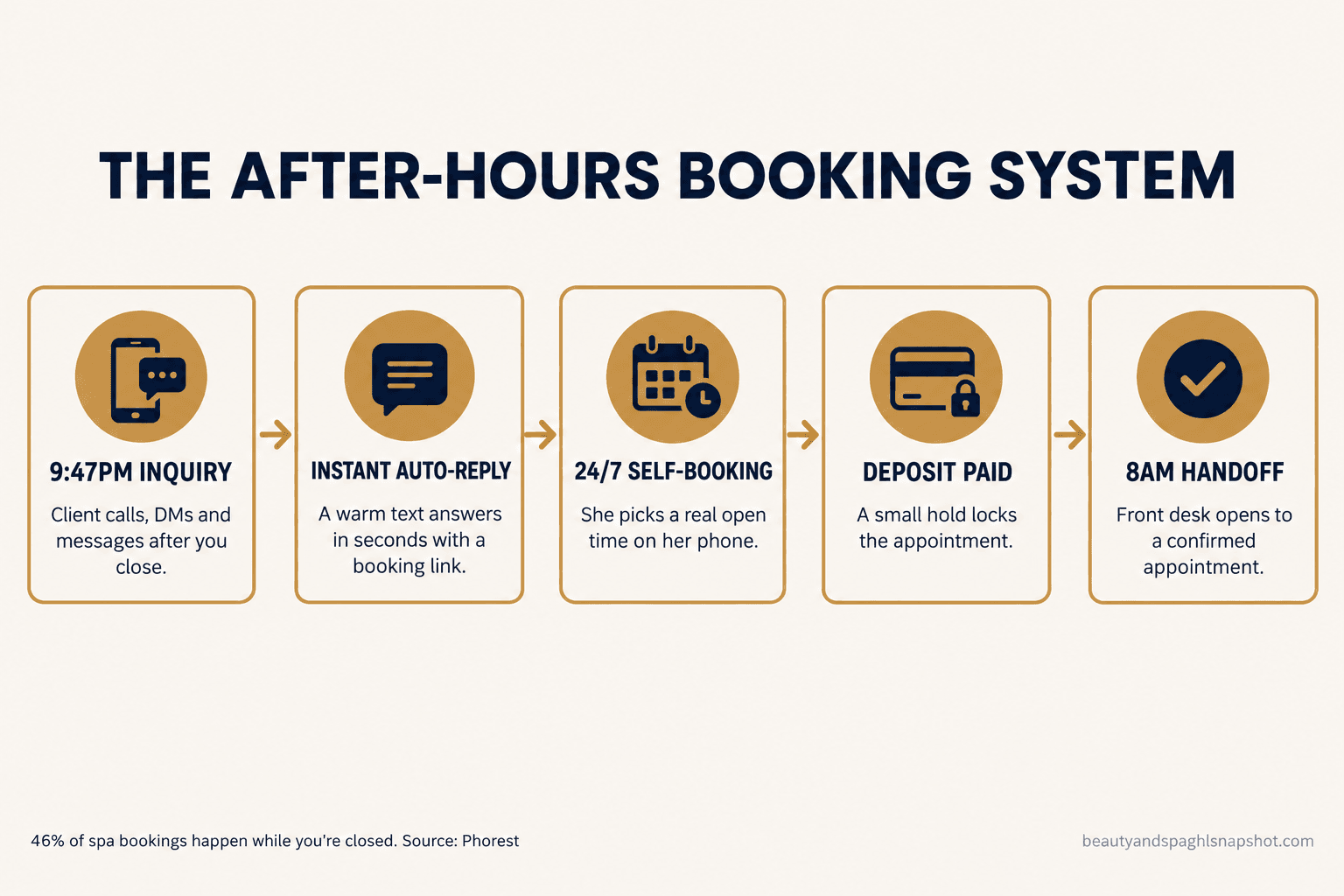
It is 9:47 on a Tuesday night. A woman in your town got the kids to bed, opened Instagram, and saw a before-and-after from a facial. She calls your studio. It rings out, because you closed at six. She sends a DM asking about Saturday. Nothing comes back, because you are asleep. By 9:52 she has booked somewhere else, at a studio whose website let her pick a time without talking to a soul.
You never saw it. There is no missed-call badge for an unanswered DM, no line item for the Saturday slot that filled at a competitor. This is the most expensive thing in your business, and it happens in the dark.
The short answer: you do not need a night-shift receptionist to catch these people. You need a system that answers the instant someone reaches out, lets them book a real time without you, takes a deposit so the slot sticks, and hands your front desk a confirmed appointment by morning. Below is the six-stage build, the message copy you can steal, and where it breaks.
On this page
- What the empty inbox costs you
- The after-hours system in six stages
- Stage 1: Missed call to instant text-back
- Stage 2: The website that books at midnight
- Stage 3: Social DMs that route to a time
- Stage 4: Google, where buyers already look
- Stage 5: The overnight deposit
- Stage 6: The 8am handoff
- Run it three ways
- Staying compliant
- Objections
- FAQ
What the empty inbox costs you
Start with when people book, because it is not when you think. Phorest looked at hourly booking patterns across more than 5,000 salons and spas and found that 54% of appointments are booked during opening hours. The other 46% land while the doors are shut: 28% in the evening after close, 18% in the morning before you open (Hairdressers Journal / Phorest). Nearly half your demand shows up when no one is there to catch it.
Share of spa and salon appointments by when they are booked. 46% land while the business is closed. Source: Phorest data on 5,000+ salons, via Hairdressers Journal.
Now layer on how people want to reach you. SimpleTexting’s 2025 survey of 1,000 US consumers found 71% want the ability to text a business back (SimpleTexting), not leave a voicemail and wait. And speed decides the rest: the Lead Response Management study led by Prof. James Oldroyd found you are about 21 times more likely to qualify a lead if you respond within 5 minutes instead of 30 (Lead Response Management study). A human cannot answer a 10pm inquiry in five minutes. An automation answers in five seconds.
The usual reflex is to throw a person at it. But a front-desk receptionist runs about $19 an hour at the national mean (US Bureau of Labor Statistics, May 2025), and covering nights and weekends means a second shift or a live answering service at a few hundred dollars a month (OnceHub). Neither books anyone at 11pm. The system below does.
The after-hours system in six stages
Think of it as a relay: someone reaches out on one of five channels, and the baton passes from “they contacted us” to a deposit-backed appointment on the calendar, with no human touching it until morning.
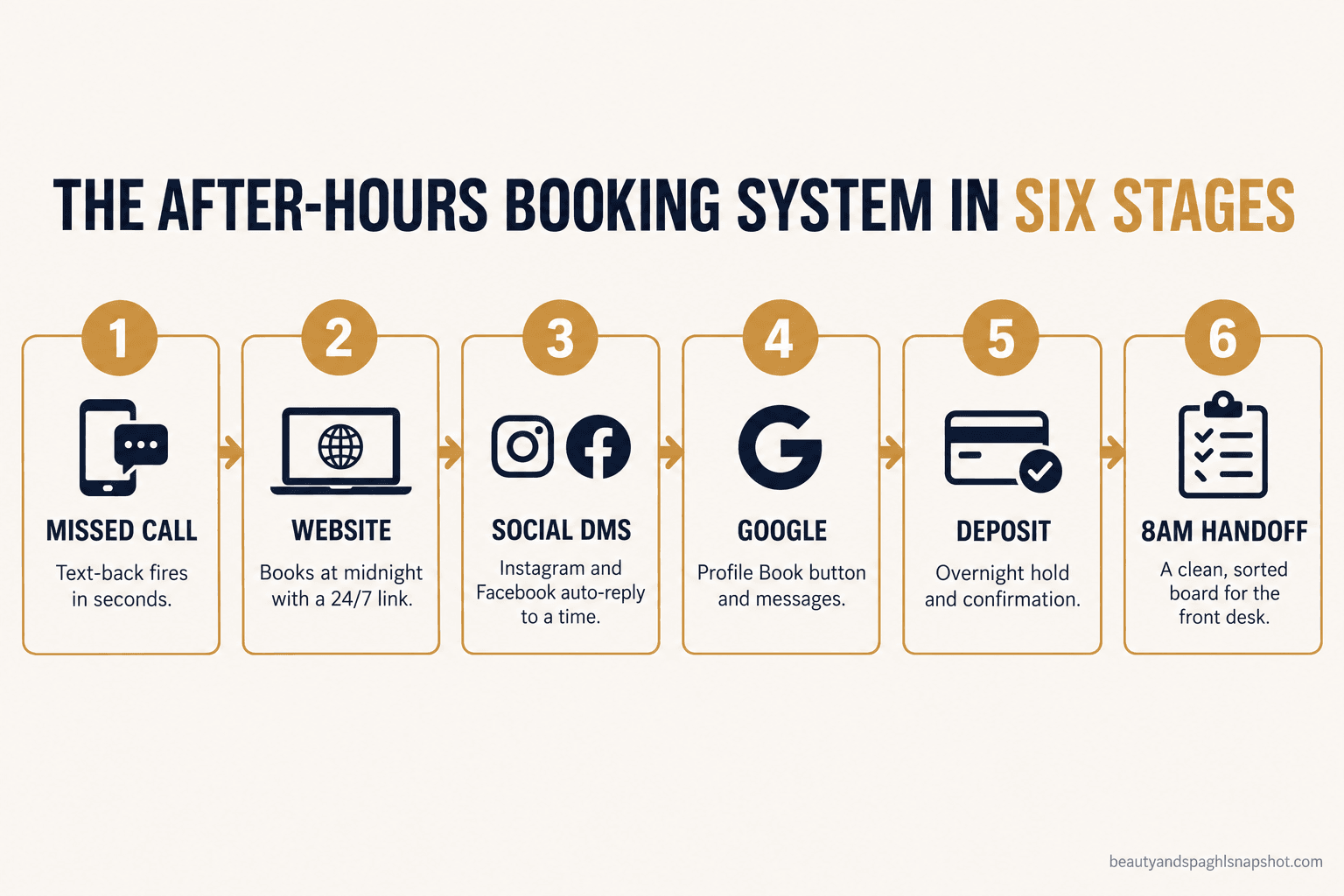
Two rules run through every stage. Every channel points at the same 24/7 booking link, because getting the client onto the booking page is the goal, not the auto-reply itself. And every message is warm and signed: “Hi, it’s Mara at Lumen Skin” beats “Your message has been received.”
Stage 1: Missed call to instant text-back
The phone is where the highest-intent people start, and a ring-out loses them fast. The moment a call goes unanswered, an automatic text fires to that number.
The copy:
Hi, this is Lumen Skin, so sorry we missed you! We’re with a client or closed for the night. Want to grab a time? Book instantly here: [link]. Or reply here and I’ll sort it in the morning. 💆
Timing: within 30 seconds, while the phone is still in their hand.
How it breaks: the text links to your homepage instead of the calendar, so a ready-to-book client has to hunt. Link straight to the booking page, and exclude staff and known numbers so you are not texting a client mid-treatment. We wrote the full version in missed-call text-back for spas, the highest-return piece of the whole system.
Stage 2: The website that books at midnight
Your website is open 24 hours a day whether you staff it or not. It needs a self-booking flow and a chat widget for the people who still have a question.
Self-booking means a real calendar showing real openings, with deposit collection built in. The client picks Thursday at 2, pays the hold, done. This is the feature that quietly won that 9:52pm booking.
The chat greeting:
Hi! We’re closed right now but I can still get you booked. 💬 Tell me what you’re after (facial, Botox, lashes) and I’ll show the next openings, or book here: [link].
How it breaks: the booking page is not mobile-first. Nearly every after-hours booking happens one-thumbed on a phone on the couch. Test the whole flow on your own phone at night; if it takes more than three taps to reach a time, fix it. A clumsy booking page is why paid clicks never convert, which we covered in why your spa is empty Tuesday through Thursday.
Stage 3: Social DMs that route to a time
This is the one most studios miss. The Instagram and Facebook DM is where a huge share of beauty discovery ends, and it is a black hole after hours. Someone comments “price?” on a reel at 10pm, it sits unseen for two days, and by then they have booked elsewhere. Set an auto-reply on Instagram and Facebook Messenger that fires on first message and on comment keywords (“price,” “book,” “info”).
The DM copy:
Hey! So glad you reached out. 🤍 Here’s our menu and live openings: [link]. Pick whatever works and you’re booked, I’ll confirm in the morning. Questions? Just reply here.
How it breaks: the auto-reply never hands off to a human, so an oddball question (“I had a reaction to a peel once, is this safe?”) gets a canned link and the person feels ignored. Always include a “reply here and a human will help” path that routes somewhere a person checks by mid-morning. The mechanics are in Instagram DM and comment automation.
Stage 4: Google, where buyers already look
When someone searches “facial near me” at night, your Google Business Profile is the storefront. The “Book” button should point at your 24/7 calendar, so a searcher never has to visit your site at all. And Google Business messages, if on, need the same instant auto-reply as your DMs.
The copy:
Thanks for reaching out to Lumen Skin! See live openings and book any time here: [link]. We’ll follow up personally tomorrow morning.
How it breaks: your profile hours are wrong or the “Book” link is dead, so Google tells people you are open when you are not, or sends them to a 404. Audit the profile quarterly, or your best midnight traffic hits a dead end.
Stage 5: The overnight deposit
This is the difference between a system that fills chairs and one that fills your calendar with ghosts. A booking made in a burst of late-night motivation is fragile; by Thursday she has cooled off. Build a small deposit or card-on-file into the booking flow, especially for high-value or new-client appointments. It filters the genuinely flaky and gives the committed client skin in the game.
The confirmation text, fired the second a deposit is paid:
You’re booked! ✨ Thursday, Nov 27 at 2:00pm with Mara, facial (60 min). Your $25 deposit is applied to your service. Need to move it? Tap here: [link]. See you soon!
Then the system runs reminders on its own: one 48 hours out, one the morning of. Deposit plus reminders is the no-show defense, and it all runs overnight. The exact amounts that get paid without scaring people off are in the spa no-show deposit policy and the no-show rate fix.
How it breaks: the deposit is too big and kills the booking, or there is no easy self-reschedule, so a client who needs to move the time cancels instead. Keep it modest ($25 to $50 for most services) and always give a one-tap reschedule.
Stage 6: The 8am handoff
The system’s last job is to make the morning calm. Your front desk should not open the laptop to 14 unread messages and a guessing game; they should open it to a clean board. The overnight relay has already sorted everything into three buckets: booked and deposit paid (nothing to do but prep), replied and waiting (a real question for a human), and no response needed (spam, or a confirmation that resolved itself). A good setup tags each conversation automatically so morning triage is a two-minute scan.
The morning follow-up, for the “waiting” bucket:
Morning! 🌞 You reached out last night about a lash fill, here are this week’s openings: [link]. Want me to hold Friday at 11 for you?
How it breaks: nothing tags the conversations, so the front desk double-texts people who already booked or lets a real question rot. If the morning only works when you personally sort it, you have not built a system, you have built a second job, which is the trap in why your spa can’t run without you.
Run it three ways
Same six stages, sized to your shop. The answer genuinely changes with your shape.
The solo operator, one chair. You cannot answer anything while your hands are in someone’s face, so the after-hours system is the only front desk you have. Start lean: missed-call text-back and a 24/7 booking link are 80% of the value, because you are “closed” to the phone even while working. One link, one text-back, deposits on.
The busy one-location spa, five or six people. You have a day front desk, so the system covers 6pm to 9am and weekends. Run all five channels; a team-sized shop gets DMs and Google messages in volume. The key addition is the tagging and handoff in Stage 6, so your coordinator starts the day with a sorted board. This shop pays the system off fastest: the demand already exists, you are plugging the overnight leak.
The multi-location shop. The trap is routing: a Scottsdale client must land on the Scottsdale calendar, not Tempe’s, or you create a mess worse than no answer. You need per-location booking links, per-location auto-replies, and a central morning dashboard so one manager can triage every location. This is also where a flat-priced system beats a per-user platform, because you are not paying a per-seat fee for every front-desk login.
Staying compliant
Automated after-hours messaging touches three rules. None should stop you, but getting them wrong can cost you.
Texting consent (TCPA). Only text people who have consented, and capture it plainly on your forms (“I agree to receive texts about my appointment”). Honor STOP immediately. Confirmation and reminder texts are transactional, which is cleaner footing than promotional blasts, but keep consent language on your forms regardless (FCC on telemarketing and consent).
Health information (HIPAA). A pure day spa doing facials, massage, waxing and lashes is generally not a HIPAA covered entity, because there is no protected health information and no insurance billing (US Department of Health and Human Services). A med spa is different once licensed providers perform medical procedures and you handle health records. The safe posture is simple: keep intake forms, consult notes and treatment photos out of plain SMS and email, and route after-hours messages to a booking page, not a request for medical history.
Reviews (FTC). If your automation requests reviews, it must ask everyone, not just the happy clients. Review-gating is a specific violation under the FTC’s 2024 rule on fake reviews and testimonials (FTC), and any before-and-after has to show typical results or disclose that results vary.
Objections
“I already pay for Mindbody or Vagaro. Doesn’t it do this?” Those platforms book appointments and have some reminders. What they rarely do is the full relay in one place: missed-call text-back, DM auto-reply on Instagram and Facebook, Google messages, and a tagged morning handoff. You can bolt pieces together and still miss the DMs. If you are weighing a switch, we mapped it in what spa software really costs in 2026.
“Do I need to be technical?” No, but it has to be wired correctly, which is where DIY attempts stall. The failure modes above are exactly what goes wrong half-built, and a half-built version catches nothing.
“What if it can’t answer a real question?” It should not try. The design routes genuine questions to a human path and tags them for the morning. The automation books the easy ones and holds the rest warmly. It is a net, not a replacement for your judgment.
The three ways to cover the after-hours window, compared
| Night-shift receptionist | Live answering service | Automated system | |
|---|---|---|---|
| Answers at 11pm / 2am | No (off shift) | Sometimes | Yes, in seconds |
| Books without you | If awake | Rarely (takes a message) | Yes, 24/7 self-booking |
| Catches Instagram / Facebook DMs | No | No | Yes |
| Takes a deposit overnight | Manually | No | Yes, automatically |
| Rough monthly cost | ~$1,600+ (part-time) | ~$200 to $700 | Runs on software you have |
| Scales to more locations | Costly (more staff) | Per-call fees rise | Add a booking link |
Monthly estimates: receptionist = ~20 hrs/week at the BLS May 2025 mean of about $19/hour; answering service = midpoint of published $200 to $700 plans; automated system reuses software you already run.
The gap is the point: a person who works nights is the most expensive option and still cannot be on the phone and in the DMs at once, while the automated system is the cheapest and the only one awake at 2am on every channel. If you would rather build the booking layer yourself, you can start a GoHighLevel account here. (Affiliate link; if you sign up through it we may earn a commission at no extra cost to you.)
Frequently asked questions
How do I let spa clients book after hours without hiring someone?
Put a 24/7 online booking link on your website, Instagram, Facebook and Google Business Profile, and set an instant auto-reply on every channel that points to it. Add missed-call text-back so a ring-out fires an automatic text with the link. The client picks a time and pays a deposit, and your front desk sees a confirmed appointment in the morning. The link and auto-replies run on their own, so no night-shift hire is needed.
What percentage of spa appointments are booked after hours?
Phorest's data on more than 5,000 salons and spas found about 46% of appointments are booked while the business is closed: roughly 28% in the evening and 18% in the morning before opening. If nothing catches those requests, nearly half your demand depends on a client coming back later, which many never do.
Is it rude to send an automated text to a client late at night?
Not if it is warm, signed and useful. A friendly text that offers a booking link reads as good service, and most consumers prefer a fast text to a voicemail. It reads badly only when it sounds like a robot or there is no human path for real questions, so keep the tone personal and include a 'reply here and we'll help' option.
Do I need to take a deposit on after-hours bookings?
For new clients and higher-value services, yes. A booking made in a burst of late-night motivation is fragile, and a modest deposit ($25 to $50) turns a maybe into a kept appointment without scaring people off. Apply it to the service and always give a one-tap reschedule link so a client who needs to move does not cancel instead.
Is automated spa texting legal and HIPAA-safe?
Automated texting is legal with consent: capture opt-in on your forms, keep an easy STOP, and honor it immediately (TCPA). A pure day spa is generally not a HIPAA covered entity, but a med spa handling medical procedures and records should keep intake forms, consult notes and photos out of plain SMS and email. Route after-hours messages to a booking page, not a request for medical history, and you stay on safe ground.
Related reading
- Missed-call text-back for spas: recover the bookings you lose to voicemail
- AI receptionist for beauty businesses: the 2026 complete guide
- The spa no-show deposit policy that actually gets paid
- Why your spa is empty Tuesday through Thursday
- Instagram DM and comment automation for med spas
- What salon and spa software really costs in 2026
The bottom line
Almost half your bookings want to happen when you are closed, and the people reaching out at 10pm are often the most ready to buy. The studios winning those bookings are not the ones with a receptionist working nights. They are the ones whose phone, website, DMs and Google listing all quietly answer in seconds, offer a real time, take a deposit, and hand the front desk a clean board in the morning.
You do not build that by checking your phone from bed. You build it once, as a system, and then it works the Tuesday night you are asleep. Start with the two pieces that recover the most, missed-call text-back and a 24/7 booking link, add the deposit, then layer in the channels and the morning handoff. The 9:47pm client is coming either way. The only question is whether your studio is awake to catch her.